
"It's Faster If I Just Do It Myself": Why LTC Leaders Take the Work Back
A continence audit sat on a leader's desk for a week.
She could have handed it off. There were people who could have done it. But it had to be updated in three places: the resident's room, the laminated sheet and the care plan. She was sure someone would miss one. So it waited, until she found the time to do it herself.
"I'm afraid that they're gonna make a mistake if I delegate," she told me. "And I'm right, they do make mistakes."
If you lead in long-term care, you know this story. You may have lived it this week.
I hear some version of "it's faster if I just do it myself" on almost every 1:1 call I have. Directors of Care say it. Managers say it. Administrators say it. This post is about why it happens, what it costs your team, and a simple way to decide what stays on your desk.
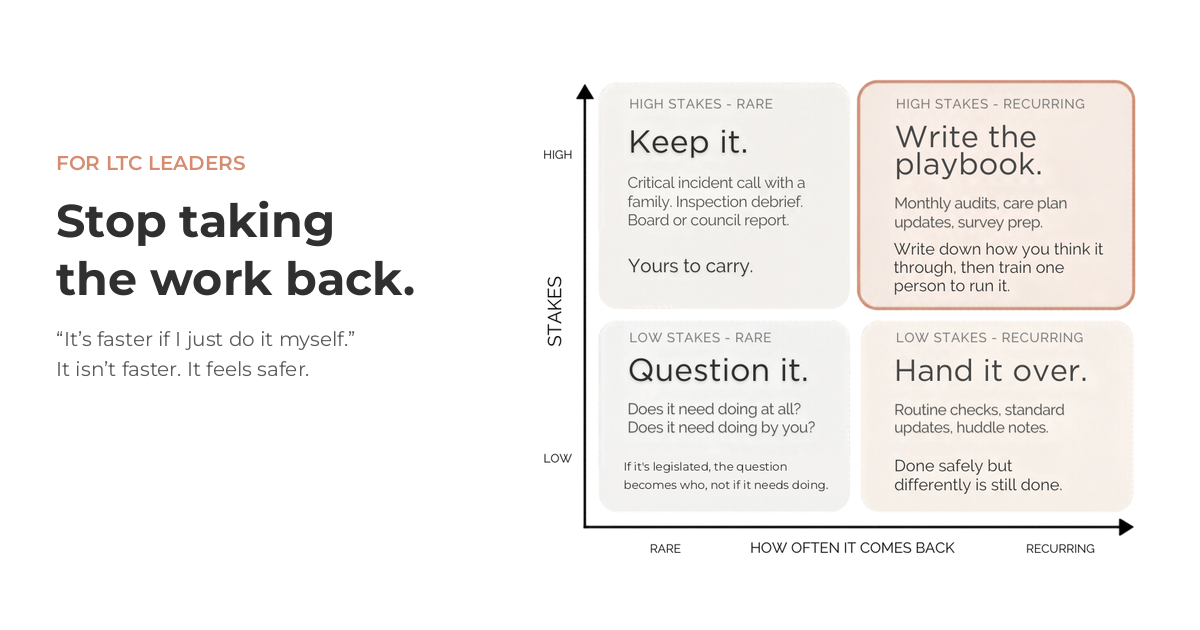
It isn't faster. It feels safer.
Where the pattern comes from
I teach LTC leaders to see the 3 Leadership Biases: Preserving, Navigating and Transmitting. Preserving tends to dominate LTC leadership. The work rewards it. Foundational care, documentation, regulatory continuity and protecting vulnerable residents all ask for a leader who organizes around stability and risk.
Preserving leaders want every piece of information they need to do a job well. If it can't be done right, they would rather not hand it off at all.
Under pressure, that leadership bias tightens. Taking the work back becomes the default protection routine. And LTC runs at a high baseline pressure.
This isn't only a Preserving habit. I hear it from Navigating and Transmitting leaders too.
Preserving leaders run it hardest, and most LTC leadership teams are full of them.
If you lead a Preserving leader
Administrators, this part is for you. When your DOC or a manager takes work back, or lets something stall, don't read it as control or disengagement. Preserving leaders often stall when they don't feel they have what they need to do it well.
Try one question: "Do you feel you have everything you need to do this well?" It speaks to what they value, and you'll often hear exactly what's missing.
The Price the team pays for it
A behaviour change problem, not a skills problem
Most leaders I work with already know how to delegate. They have trained staff, run audits and coached people through hard conversations. One leader told me she knows exactly what needs to change. She just can't see how to do it without compromising the quality of her work.
That's a behaviour change problem. Another delegation workshop won't fix it. Seeing the pattern clearly is where change starts.
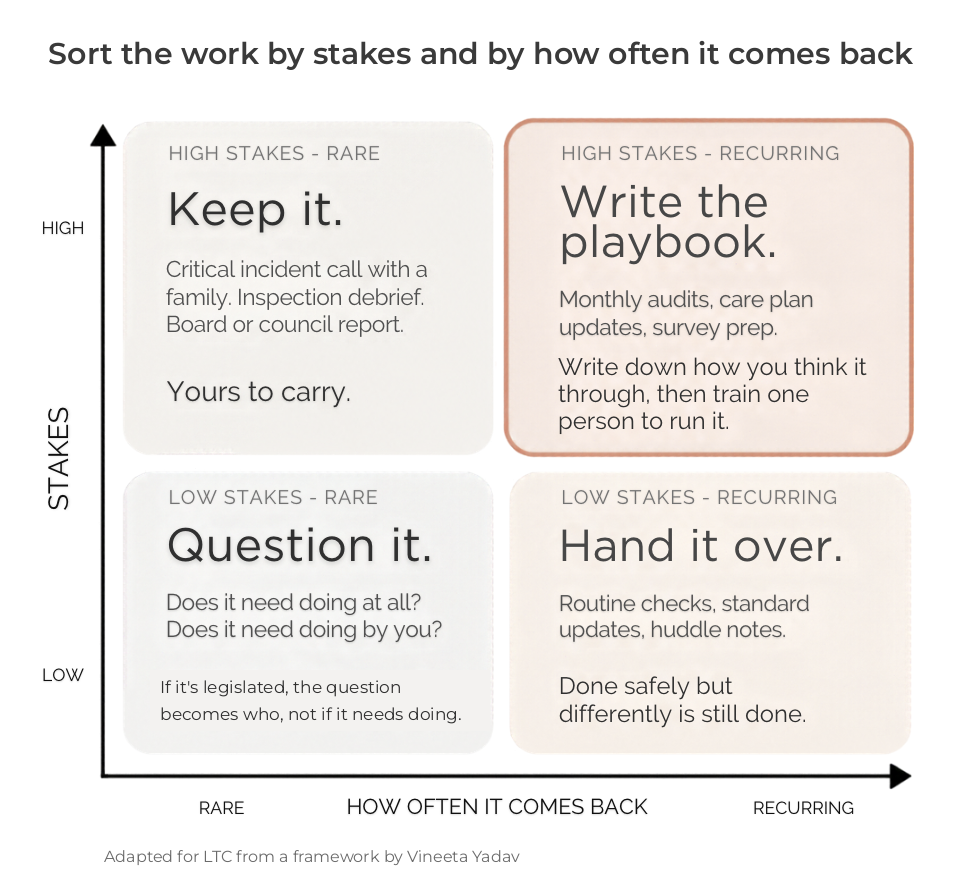
A 2x2 grid sorting leadership tasks by stakes and how often they recur: Keep it, Write the playbook, Question it, Hand it over.
Keep it (high stakes, rare). The critical incident conversation with a family. The inspection debrief. The report to your board or council. These are yours to carry.
Write the playbook (high stakes, recurring). The monthly audit. Care plan updates. Survey prep. If it's critical and it comes back every month, keeping it in your head makes you the bottleneck. Write down how you think it through, what done right looks like and where people usually slip. Then train someone to run it.
Hand it over (low stakes, recurring). Routine checks, standard updates, huddle notes. If it's done safely but differently from how you'd do it, it's done.
Question it (low stakes, rare). Vineeta's version says drop it. In LTC, much of what fills your week is legislated, so dropping it isn't always an option. Ask a sharper question. Does this need to be done, and does it need to be done by me?
How to start: one task, one person
Pick one task from the playbook or hand-over boxes. Choose something recurring, so you get more than one try.
Pick one person who shows leadership potential and is open to feedback. That might be a PSW on the floor, not only a manager.
Show them what done looks like to you. If they don't know, they'll do it their way.
Check the first one closely. Give feedback. Check the second one more lightly.
Expect it to take longer at first. You do get your time back. It just won't feel that way in the first few weeks.
A closing thought
The leader who takes the work back is rarely the one who cares least. Usually it's the one who cares most, carrying more than anyone can see.
Respond, don't react. The next time you reach for something you've already handed off, pause and ask which box it belongs in.
A question to sit with: What is one thing on your desk this week that belongs in someone else's hands?