Why the same hard conversation keeps showing up in your leadership team
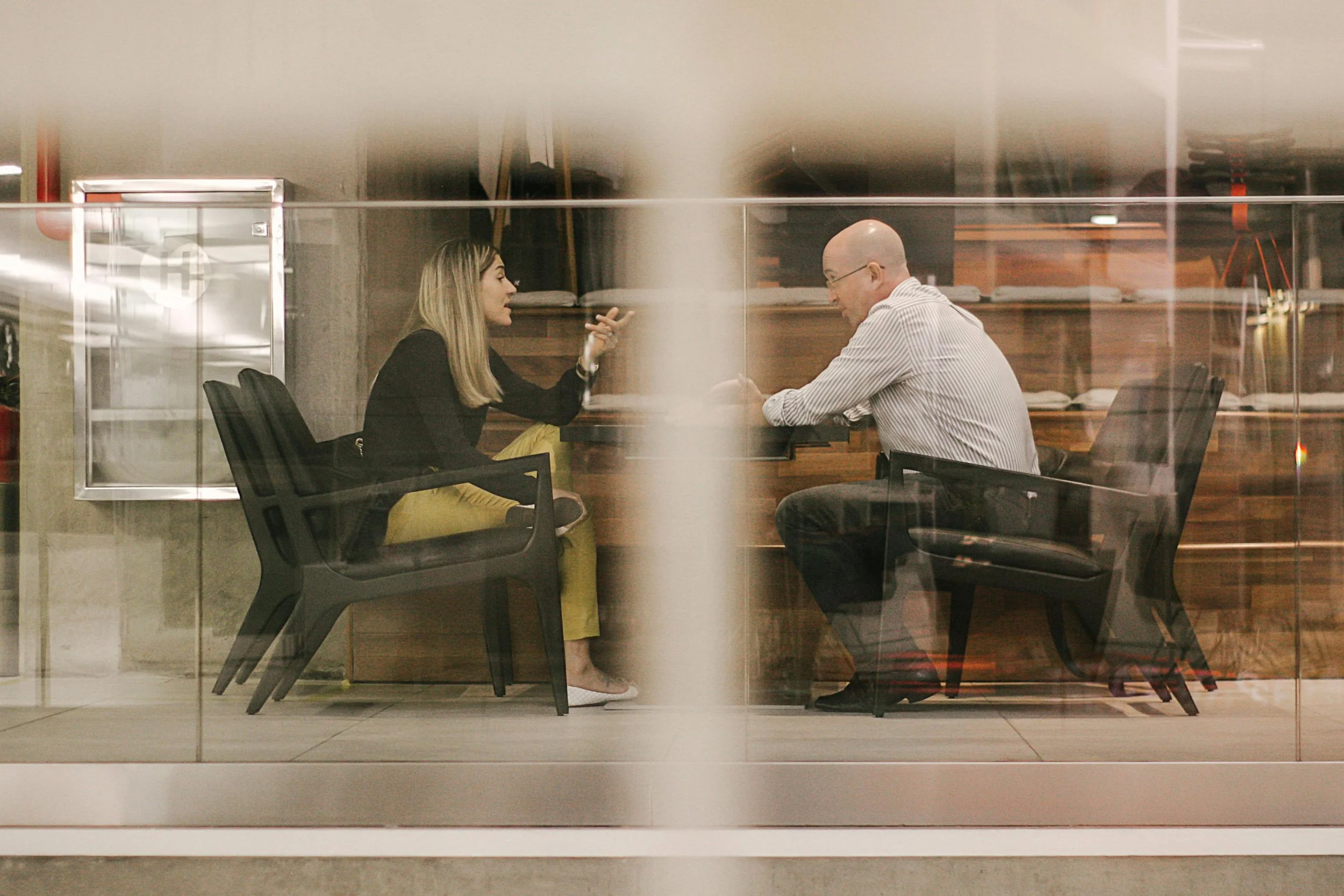
Two people sitting having a hard conversation
There's a hard conversation happening on your leadership team right now that's been happening for months. Maybe years. The faces and the topics rotate, but the dynamic underneath keeps showing up, the same person going quiet, the same person pushing too hard, the same unresolved tension that no one quite knows how to name.
When I describe that pattern to an Administrator on a discovery call, they recognize it immediately. The next question is usually whether the work I do is something they've heard of before. Is that like Myers-Briggs? Sometimes it's the one with the four colours?
I understand the question. They're trying to file this new thing into a familiar category, personality test, communication style inventory, the kind of tool that gives everyone a label they'll mostly forget by the next quarter.
It's not like those. The framework I work with is called the ATA Enneagram. It was developed by Mario Sikora and Maria Jose Munita, who built it specifically for leaders, teams, and organizations. What it gives you is a precise, behavioural map of how each personality type pays attention, makes decisions, and responds under pressure.
That distinction matters more than it sounds.
What most personality tools won't tell you
Strengths assessments tell you what a leader is naturally good at. DISC tells you their communication style. Myers-Briggs tells you a four-letter category they'll recognize themselves in.
None of those tools tell you why your Director of Care avoids a hard conversation for six weeks. None of them explain why your strongest manager goes quiet in front of the union rep. None of them give you language for the pattern where one leader over-functions, another disengages, and the team's energy quietly drains out the bottom.
Try running a performance conversation off a Strengths report. You can name what the leader is good at, but you can't name what's actually getting in the way — what's driving the behaviour you need to address. The conversation either softens into praise, or it leaves the framework entirely and becomes about character. Neither one moves anything.
That's the work the ATA Enneagram does. It names the patterns underneath the behaviour — what the person is paying attention to, what they're protecting against, and what they reach for when stress arrives. In an LTC home, where stress isn't an event but a baseline, that level of precision is the difference between a leadership team that can navigate hard moments and one that fragments under them.
The three Leadership Biases
The ATA framework organizes nine personality types into three larger patterns called the Instinctual Biases, I call them Leadership Biases. They show up in every leadership team I work with, usually in collision.
Preserving leaders pay attention to security, stability, and what could go wrong. In LTC, they're often the people holding the operational backbone together, and the people most exhausted by it.
Navigating leaders pay attention to relationships, group dynamics, and how the team is functioning together. They're often the connectors, and the ones who absorb the most emotional weight without anyone noticing.
Transmitting leaders pay attention to influence, expression, and impact. They're often the ones who push initiatives forward , and the ones whose intensity can read as pressure to a team that's already maxed out.
None of these is better than another. All three are needed on a leadership team. But when leaders don't know which bias is theirs, every conflict feels personal, every hard conversation feels riskier than it is, and every cohesion problem looks like someone needs to change who they are.
That's the wrong diagnosis. And it's where most leadership development quietly fails.
What this changes for team conflict
Most team conflict in LTC leadership isn't a character problem. It's a bias collision. A Preserving Director of Nursing and a Transmitting Administrator will read the same situation completely differently, one sees risk that needs containing, the other sees momentum that needs protecting. Without language for what's happening, they end up labelling each other: resistant, reckless, negative, unrealistic.
With language for what's happening, the same conversation becomes survivable. Not easy. Survivable. And repeatable.
What this changes for hard conversations
Most LTC leaders I work with want to have hard conversations. They also don't know how, and many quietly believe their job is at risk if they get it wrong. So the conversation gets pushed up, to HR, to the union process, to a coach. The underlying dynamic doesn't shift.
Underneath that hesitation, leaders avoid hard conversations in patterned ways that track directly to type. Some delay because they need more information first. Some delay because they don't want to damage the relationship. Some delay because they're scanning for the version that protects their authority.
Once a leader can see their own pattern, not as a flaw, just as data, the avoidance loses some of its grip. They stop arguing with themselves about whether to have the conversation. They start asking the better question: what does this specific conversation need from me, given how I'm wired to default?
That shift is where behaviour starts to change. Not after a workshop. After awareness becomes specific enough to act on.
What this changes for team cohesion
Cohesion isn't built by getting everyone to like each other. It's built by giving each leader a clear, non-blaming framework for understanding their own patterns and the patterns of the people they lead alongside. When the Director of Care knows that her Environmental Services counterpart isn't being difficult — he's Preserving, and he's protecting against a risk she hasn't named yet, the conversation changes. The story she tells herself about him changes. The story the team tells about both of them changes.
That's cohesion. Not warmth. Accuracy.
Why I use this one and not the others
Most leadership development assumes the problem is a skill gap. It isn't. Leaders under stress revert to patterns developed long before any development happens, habits that feel like identity. Generic training in a culture where blame and avoidance are normalized doesn't shift those patterns. Sometimes it reinforces them.
The ATA Enneagram is built for that exact problem. It's diagnostic before it's developmental. It tells the truth about how each leader actually operates, in a language they can carry into Monday morning. And it does that without asking anyone to become a different person — only to see, clearly, the one they already are.
If your leadership team is struggling with conflict, hard conversations, or cohesion right now, the question worth sitting with isn't who needs to change?
It's what patterns are we mistaking for personalities, and what would shift if we could finally name them?